How to Play Selected Audio Again and Again in Audacity
Audacity offers many tools which allow the user to play all or part of a sound. There are also many recording options.
Contents
- Controlling Playback and Recording
- Transport Toolbar
- Using keyboard shortcuts
- Adjusting the Playback volume
- Playing at slower or faster speeds than normal
- Pinned caput Playing and Recording
- Playback
- Quick-Play using the Timeline
- Scrubbing and Seeking
- MIDI (and Allegro) Playback
- Recording
- Overdubbing
- Timer Recording
- Sound Activated Recording
Controlling Playback and Recording
Ship Toolbar
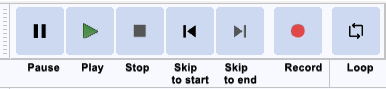
The easiest style to control Audacity playback and recording is with Send Toolbar:
-
 Clicking Play plays from the cursor point to the end of the project, or from the start of the choice region to the terminate of that region.
-
-
 Play Cut Preview will play audio either side of a option to preview what deleting the selection volition sound like. Agree down Ctrl (⌘ on Mac) while clicking Play.
 - Alternatively you tin can utilize the C shortcut to preview the cut. This also causes the Play button prototype to change to Play Cut Preview.
-
Clicking Play when the runway is already playing or paused is a quick way to restart playback without first pressing Stop.
-
 Clicking Record or using the R shortcut ever begins recording at the end of the currently selected track(s).
-
-
 The alternative Record New Rails action for the Record button is activated past holding Shift while clicking Tape. The button changes to display the Record New Track icon. This will start recording in a new track at either the current cursor position or at the showtime of the current selection.
-
-
 Click Interruption, or its shortcut P, to temporarily pause playing or recording without losing your place. Click Pause a 2d fourth dimension to resume.
-
 Clicking Stop stops playing or recording immediately, and releases Pause if depressed.
-
- Click Loop, or information technology's shortcut L to set a loop region. When you utilise it the first time, information technology'll set your current option to the loop region. If you printing Play with looping enabled, information technology will loop the current loop region over and over.
Using keyboard shortcuts
When you get more used to Audacity, it is often easier to use keyboard shortcuts for repetitive deportment like playing, pausing and recording. Below is a list of the equivalent keyboard shortcut for each of the Transport Toolbar buttons, with a description of what each button and its shortcut does.
-
Button Shortcut What it does Pause P Press one time to interruption playback or recording then once to resume. Play or Stop Space Press in one case to commencement playback so once to stop. Starting playback again starts from its original starting position at the cursor. Play/Cease and Fix Cursor X This acts exactly like Space when starting playback, just when used to cease, the cursor or start of the selection is set to the position where playback was stopped. Play to Selection B Plays to or from the electric current mouse pointer position to or from the start or end of the selection, depending on the pointer position. Play Cutting Preview C Plays two seconds of sound earlier the option and then one second of audio after the pick - thus simulating what playback would sound like if the choice was deleted.
The times are customizable in Playback Preferences.Loop on/off L Enables looping, in which the loop region will be played over and over upon pressing space. Play In one case Shift + Infinite Plays the looping region only once when looping is enabled. Motion to Next Label Alt + Right Places the editing cursor or selection to represent with the next label and restarts playback from there, without opening the characterization for editing. After the concluding characterization is reached, using the shortcut over again jumps playback to the offset label. Non bachelor while recording. Move to Previous Label Alt + Left Places the editing cursor or pick to correspond with the previous characterization and restarts playback from in that location, without opening the label for editing. After the first characterization is reached, using the shortcut once more jumps playback to the final label. Not bachelor while recording. Skip to Start Domicile Move the cursor to kickoff of project. Skip to End End Movement the cursor to end of projection. Record R Record starting from the cease of the selected track(south). Record New Rails Shift + R Record in a new rails starting from the cursor position or offset of the pick.
Adjusting the Playback book
You lot can adjust the playback volume using the output level slider in the Mixer Toolbar.
The Playback Meter volition show you the overall book of all of your tracks when mixed together.
Playing at slower or faster speeds than normal
Using the Play push in Play-at-Speed Toolbar plays at a abiding speed only slower or faster than normal.

Envelope Tool on the Tools Toolbar, when used in conjunction with a Time Track, allows a speed envelope to be fatigued which can increase or decrease playback speed over the length of the audio.
Pinned head playing and recording
You can modify Brazenness to play and tape with a fixed head pinned to a position in the Timeline. In this mode the caput remains static and the waveforms volition move as the audio is played or recorded.
This beliefs is controlled past using the button at the left of the Timeline. By default this shows every bit a light-green down-pointing triangle (similar the play head). In this manner, the play head or record head volition move horizontally and the waveform will roll when necessary, except that if Automobile-scroll if head unpinned is unchecked in Tracks Preferences then scrolling will not occur.
Clicking on the greenish triangle will cause a context card to be popped up. From that context card you tin check on Pinned Play Caput. This will cause the button icon to modify to a drawing-pivot which indicates that the play caput or record caput is now pinned to the middle of the Timeline and when playing or recording takes place the waveform volition movement continuously under the fixed caput.
Unpinned or pinned caput can likewise exist selected in .
 | The default pinned position is the center of the Timeline, but you can change this past clicking on the pinned head and dragging it forth the Timeline while y'all are playing or recording. A double-click on the caput volition restore information technology to its default position in the middle of the Timeline. You may find that centered is the most useful when using playback but for recording, repositioning the caput to the correct may exist useful. |
For details on setting and un-setting pinned play and tape head please run into Pinned Play/Tape Head on the Timeline page.
Playback
For fuller details of how to use playback, including keyboard shortcut commands and how to preview brusque sections, please see the Playback page.
Quick-Play using the Timeline
Timeline Quick-Play provides a quick and convenient means to either first playback from any indicate within the current projection or to playback a region of audio.
For details run into the Quick-Play section on the Timeline page.
Scrubbing and Seeking
Scrubbing or Seeking is the activeness of moving the mouse pointer correct or left so as to adjust the position, speed or direction of playback - a convenient mode to quickly navigate the waveform to find a item event of interest.
Scrubbing or Seeking in Brazenness is initiated by using the Scrub button  or Seek button
  in Scrub Toolbar
  . Alternatively y'all tin use the carte du jour item and select or from the cascading carte du jour.
Audacity will remain in scrubbing/seeking style until you return information technology to normal play fashion. Clicking the Stop button (or its shortcut Space) at any time will cease scrub/seek play and return you to normal play mode moving the cursor to the current scrub/seek play position. If you wish to stop scrubbing or seeking without losing the position of the editing cursor or option, utilize the Escape Esc fundamental.
Please see Scrubbing and Seeking for details
MIDI (and Allegro) Playback
MIDI (and Allegro .gro) files tin exist imported into Audacity with to a Annotation Rail.
Audacity tin can now play these MIDI (and Allegro) files, simply note that in that location volition no utilise of the Playback meter while Annotation tracks are played. Although Note track playback should just work on Windows, on Mac and Linux boosted software may exist required.
Editing these Note tracks is possible, only very express.
For more details please see: Note Tracks.
Recording
For fuller details of how to utilise recording, including how to control where and which rail you record in and keyboard shortcut commands, please see the Recording page.
When you click the Tape button on Transport Toolbar, or apply the R, Audacity will record at the finish of the currently selected (or only) track, or create a new runway if you have an empty project.
When recording similar this, at the end of an existing recording, Audacity will place a Prune line at the junction betwixt the two recordings to assist you in separating them later on if required. See the Recording folio for details.
| | When making recordings, item critical recordings, yous should consider shutting down all other applications giving Audacity sole apply of the calculator. This can assistance to avoid skips, small dropouts, and ticks in your recordings. And on Mac that means fully Quitting them not only closing them, every bit otherwise Mac will get out them open consuming computer resources. |
Overdubbing
You tin can record a new track while listening to previously recorded tracks. This is called overdubbing. To prepare upwards for overdubbing, make certain that is enabled (on) which is its default setting. See the tutorial set Recording Multi-rail Overdubs for more help with overdubbing.
| | Before overdubbing it is recommended to perform a latency examination to determine the optimum latency correction, then ready the value of Latency correction in Devices Preferences.
|
If you hold the button downward the Record button in Transport Toolbar will temporarily modify to . Then clicking on this modified Record button, or using the shortcut Shift + R will cause Audacity to create a new track and begin recording on that track from the electric current cursor position (or from the left border of a region on the Timeline).
If there is a region in the Timeline, that region will be recorded in a new rail.
Timer Recording
Yet another way to record is using the Timer Record utility, found in the Send Menu.
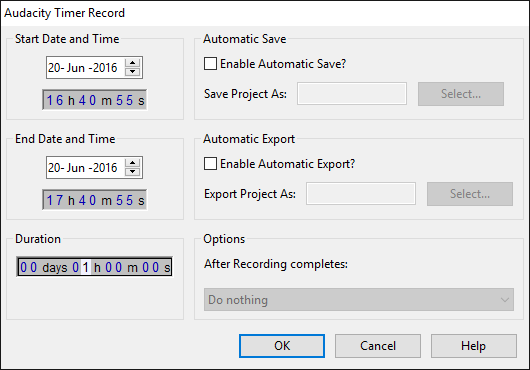
Use it to first recording later, or to record for a certain duration before stopping.
Sound Activated Recording
If you turn on yous can make recording interruption until the input level exceeds the specified threshold level at .
Links
> Quick-Play
> Scrubbing and Seeking
> Timer Recording
> Punch and Roll Recording
Source: https://manual.audacityteam.org/man/playing_and_recording.html
0 Response to "How to Play Selected Audio Again and Again in Audacity"
Post a Comment